
Day 69 (3/21): The Long Now


The Clock of the Long Now, designed by Daniel Hillis and the Long Now Foundation, is a clock designed to run accurately without interruption and maintenance for 10,000 years. Find out more about how it works here and here and here.
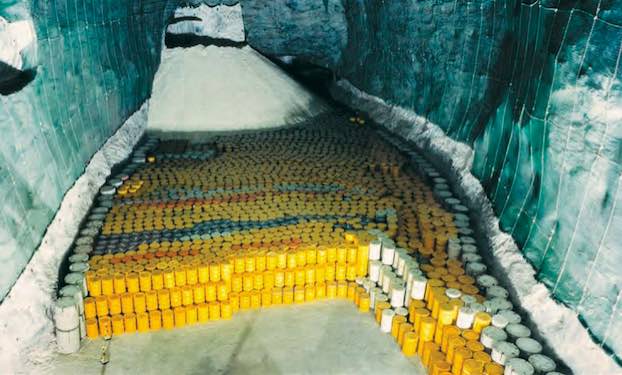


Consider:
The half-life of enriched uranium (Uranium-235) is 704 million years. That of depleted uranium (Uranium-238) is 4.5 billion years. All of the nuclear waste that has ever been created by humans--that continues to be created at a rate of over 3,000 tons per year in the US alone--will continue to exist and be deadly for longer than the life of the sun.

The Waste Isolation Pilot Plant (above) is a storage facility in southeastern New Mexico designed to "safely" store nuclear waste.  This site is only for "so called low- and midlevel waste,"  but its contents, many thousands of tons of contaminated clothing, building materials, and equipment, are and will remain poisonous beyond any future we can image (Weisman).

The longest continuously-existing civilization, at upwards of 3,500 years, is that of China. Suffice to say that the poison filling the ground will likely outlast any remnant of the civilization that put it there. According to its federal mandate, the operational performance period for the WIPP is 10,000 years.

10,000 Years Activity

After we complete the activity, we can listen to this 99% Invisible episode, which tells the true story of solving this problem.

Comments

Popular posts from this blog

Day 64 (3/7) Intro to Ethics: The Trolley Problem

   Let's begin by watching the following videos, explaining the famous "Trolley Problem", a thought experiment to demonstrate some key ethical dilemmas: After you watch the video, think and discuss: How would you behave in the first example?  What motivates this decision? How about in the revised example?  What, if any, difference is there in your reaction?  What creates this difference? What other modifications to the problem can you come up with that would focus the dilemma in other interesting ways? Finally, this dilemma is not realistic, but we should think about real-world instances of "trolley problem" thinking at work.  Here's one of  my recent favorites . (other take  here  and  here ) This TedEd Video offers some historical and social context to this problem. And now you smart enough to get this Existential Comics cartoon:

Day 59 (3/22): The Black Box Problem

"What's in the box?!" -Brad Pitt   Let's begin our discussion of science with a quick POP QUIZ!!! After you are done, put your quiz someplace safe.  We'll come back to it soon to check your initial understanding. Now, we will try some hands on science with my favorite TOK activity: THE  BLACK BOX  PROBLEM I will put you in teams of 3-4 students.  Together, you will work together to discover the nature of the universe. Please follow along on  these instructions  as I explain.