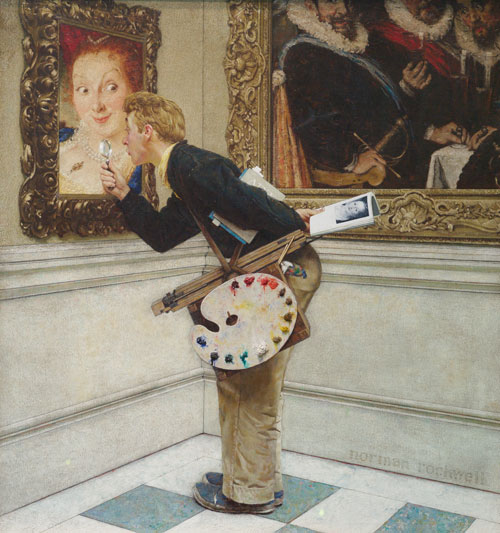
Day 52 (1/25): Art & Judgement


Aims & Objectives
  • make connections between a critical approach to the construction of knowledge, the academic disciplines and the wider world
  • develop an awareness of how individuals and communities construct knowledge and how this is critically examined
  • examine how academic disciplines/areas of knowledge generate and shape knowledge
Key Questions
  • What is the role of judgement in art?
  • How do we justify our opinions about art?
  • What makes art good?

Start with these clips.  The first comes from Terry Zwigoff's Art School Confidential, based on the short comic by Daniel Clowes.


The second is from Zwigoff's earlier film, Ghost World (2001), based on the Clowes' comic series turned graphic novel.


Now return to your "Art Starter" activity and look at the list of works of art that you generated.  For each work (or for all of them together), list some qualities (of the work, its production, its history?) that make the art worthy of being called art.

So the question is maybe not "Is it Art?" but "Is it Good?" and if so, "How can we claim to know such a thing?"

  • "The Art Critic" Activity

By Friday, 1/21

Read and annotate the excerpt from Bourdieu's "Sociological Theory of Art Perception" Come to class having written down:
  • 3-4 key ideas or observations drawn from the text.
  • 2-3 significant (knowledge) questions that the text seems to raise.

Comments

Popular posts from this blog

Day 64 (3/7) Intro to Ethics: The Trolley Problem

   Let's begin by watching the following videos, explaining the famous "Trolley Problem", a thought experiment to demonstrate some key ethical dilemmas: After you watch the video, think and discuss: How would you behave in the first example?  What motivates this decision? How about in the revised example?  What, if any, difference is there in your reaction?  What creates this difference? What other modifications to the problem can you come up with that would focus the dilemma in other interesting ways? Finally, this dilemma is not realistic, but we should think about real-world instances of "trolley problem" thinking at work.  Here's one of  my recent favorites . (other take  here  and  here ) This TedEd Video offers some historical and social context to this problem. And now you smart enough to get this Existential Comics cartoon:

Day 59 (3/22): The Black Box Problem

"What's in the box?!" -Brad Pitt   Let's begin our discussion of science with a quick POP QUIZ!!! After you are done, put your quiz someplace safe.  We'll come back to it soon to check your initial understanding. Now, we will try some hands on science with my favorite TOK activity: THE  BLACK BOX  PROBLEM I will put you in teams of 3-4 students.  Together, you will work together to discover the nature of the universe. Please follow along on  these instructions  as I explain.